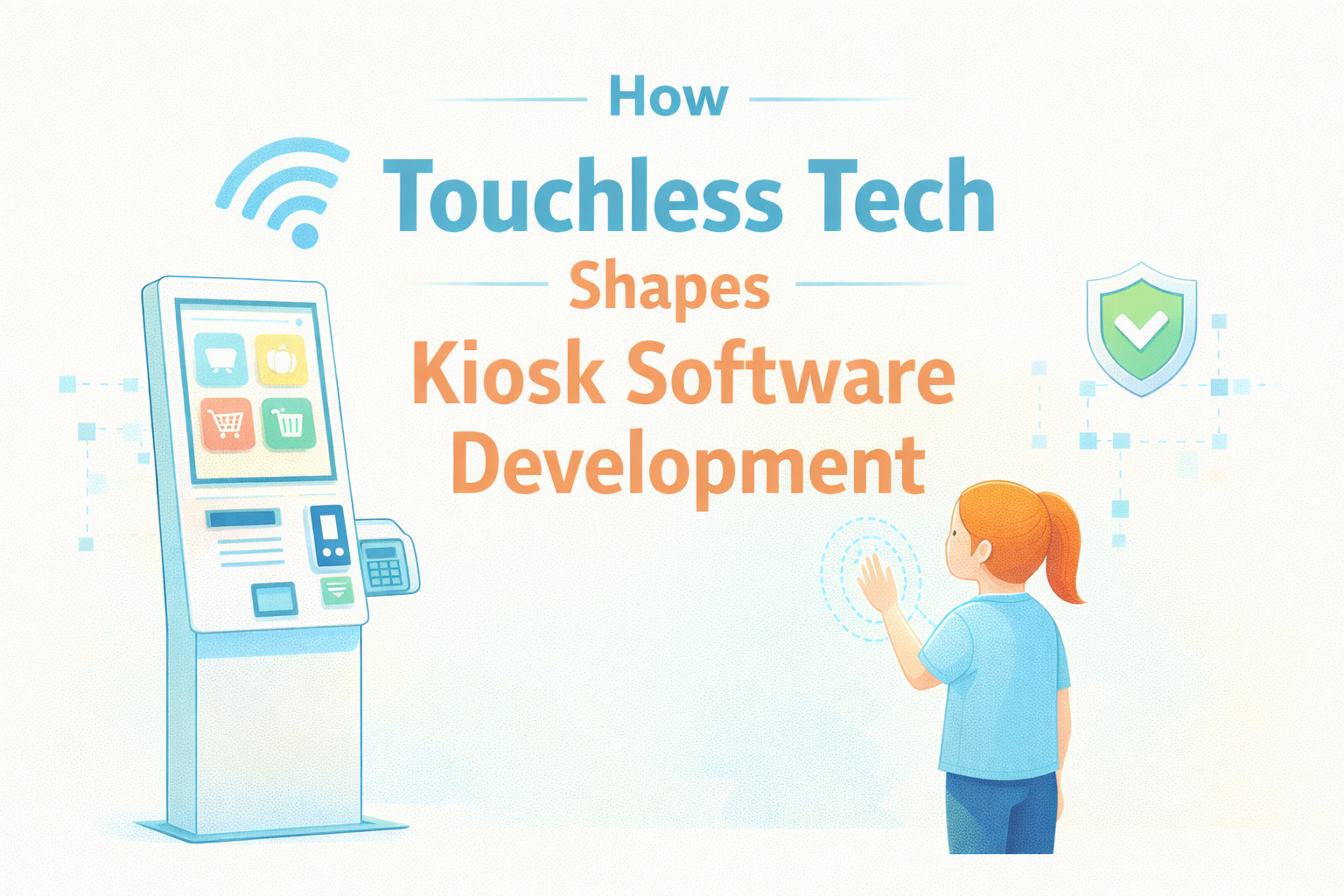
In a world where customers demand speed, safety, and convenience, touchless technology is no longer just a novelty; it has become a necessity. A lot of businesses are going the way of digitization and are coming up with new ways of how users can interact with physical digital systems, without making physical contact. Artificial intelligence (AI), combined with contactless interfaces, is at the core of this transformation, primarily enabled by AI kiosk software development services.
This write-up examines touchless technology as a key driver of modern kiosk software, the role of AI, and what service providers should know before taking the next step in kiosk solutions.
Touchless Technology Turning Point in Kiosk Ecosystem
The emergence of touchless technology was not a surprise to many. Initially, the most interactive part of the early kiosks was the use of touchscreens, PIN pads, and physical buttons, but due to changes in consumer behavior and the global pandemic, the latter has accelerated the adoption of contact-free interactions. Kiosks nowadays operate through voice commands, facial recognition, gesture control, QR scanning, and mobile-based interactions.
For businesses, the transformation is not just about the prevention of the spread of the virus, it is mainly about the users’ experience and the business’s operational efficiency. Touchless kiosks help reduce wait times, improve the user experience, reduce bad interactions, and offer personalized interactions even without user input. Organizations ranging from fast-food chains to healthcare providers are coming to the realization that touchless kiosks are capable of dealing with intricate workflows and, at the same time, are user-friendly.
The changes at the software level require a more profound integration of AI models, on-the-spot data processing, and user interfaces that can adjust by themselves. Traditional kiosk software frameworks are now inadequate; hence, there is a rapid increase in the call for AI-based kiosk platforms.
Artificial Intelligence (AI) Is the Core of Touchless Kiosk Software
Without a certain degree of intelligence behind the scenes, touchless functionalities would not be feasible. Artificial intelligence is the technology that enables kiosks to “understand” their users as opposed to waiting for manual input. This is where the role of AI kiosk software development services is very crucial.
Artificial intelligence enables accurate voice recognition, secure facial recognition, gesture analysis, and contextual responses. For instance, a smart retail kiosk may recognize a returning customer using facial recognition (where permitted by law) and make a product recommendation immediately. Likewise, a medical check-in kiosk may confirm the identity, understand the spoken language, and help the patients without any contact at all.
The main AI capabilities leading the way to the establishment of completely touchless kiosks are:
- Computer vision for facial recognition, object detection, and gesture tracking
- Natural language processing (NLP) for voice-based navigation and multilingual support
- Machine learning for behavior analysis and personalized experiences
- Edge AI for faster processing and reduced dependency on constant cloud connectivity
Such abilities convert kiosks from being merely static machines into digital assistants that are capable of adapting, learning, and improving over time.
Touchless Interfaces and User Experience Redefined
One of the most profound changes brought about by touchless technology has been observed in user experience design. Because the touchscreen is not the primary interface, kiosk software developers must develop entirely new interaction flow strategies.
Use of voice interfaces comes first in many cases, mainly where a user is supposed to be at an airport, hotel, or hospital. Even so, voice on its own is not always enough. Contemporary touchless kiosks have the capability of using as many as six (viz. voice, mobile devices, and visual cues) to facilitate accessibility and usability of all users, thus, they ensure that no one is left out.
On the software side, this is about creating UI/UX systems that are flexible and can dynamically adapt to input. AI-driven kiosks can observe where a user hesitates, change prompts, and on top of it, if one method fails, they can even go a step further and switch automatically into another interaction mode.
For businesses in quest of services, this makes working with development teams that are conversant both in AI logic and human-centered design very important. The aim is not only automation, but also intuitive engagement, which is most liked by the end user.
Security, Privacy, and Compliance in Touchless Kiosks
The more intelligent and autonomous kiosks become, the more complicated the security and privacy issues that need to be considered. Usually, touchless kiosks depend on biometric data, voice recordings, or behavioral patterns ,and these are things that should be dealt with in a responsible manner.
The software for AI-powered kiosks should be equipped with strong encryption, secure authentication methods, and compliance with the data protection laws of the regions. It is especially important in the case of industries such as finance, healthcare, and government services.
From the perspective of a service buyer, it is very important to make sure that AI kiosk software development services are in favour of privacy-by-design principles. AI models must take care of the sensitive data very securely, provide anonymity where it is possible, and give the users the opportunity to see when their data is stored and how it is used.
Trust is one of the fundamental elements of kiosk adoption. Without it, even the most advanced touchless technology will have a hard time being accepted by users.
Operational Benefits for Businesses Adopting Touchless AI Kiosks
On top of the advantages that users face, touchless kiosks also provide measurable operational benefits. The AI-driven software responsible for most kiosk functionalities can be less dependent on human supervision, reducing maintenance costs and improving system uptime through predictive analytics.
For example, AI can keep track of a kiosk’s real-time performance, spot odd behavior, and, if necessary, it can also send a pre-failure warning call automatically. Additionally, it can examine the occurrence of activities to not only simplify the workflow but also adjust the content or suggest upgrading hardware.
Organizations that are utilizing AI kiosk software development services are in a position to announce that they are benefiting from:
- Faster customer throughput
- Reduced staffing pressure
- Improved data-driven decision-making
- Greater scalability across locations
All this good work turns the touchless kiosks into a strategic investment that is far from being merely a technology upgrade.
Customization and Scalability Through Intelligent Software Design
The absence of two similar businesses indicates different requirements, with flexibility in modern kiosk software development and touchless capabilities as two of the most important. Being able to customize a touchless kiosk to fit certain sectors, conditions, and users is quite essential.
AI makes this modification possible on a large scale. Modular architectures enable businesses to install kiosks with industry-specific features while retaining a standard core platform. Some companies are turning toward low-code application development to facilitate customization and internal updates without the need for a complete system rebuild.
Scalability is a must for any organization that is looking forward to long-term growth. AI-powered kiosks can be deployed across various areas, updated remotely, and benefit from continuous learning on new data to improve performance. Their flexibility is the strongest argument among intelligent kiosk platforms investment proponents against sticking with legacy systems.
Understanding AI Kiosk Software Development Cost Factors
Businesses often inquire about the cost of AI kiosk software development. Although the price varies significantly, by knowing the main cost drivers, one can have a better idea of what to expect.
Cost factors typically include:
- Complexity of AI features (voice, vision, personalization)
- Level of customization required
- Integration with existing systems (POS, CRM, ERP)
- Security and compliance requirements
- Ongoing maintenance and model training
Compared to systems with fundamental touch-based operations, the AI-driven kiosks are likely to have a higher initial cost. However, the latter becomes more and more attractive over time due to the great ROI that it achieves through automation, efficiency, and enhanced customer satisfaction.
Many service providers have an offering of development phases by which businesses start with the core features and have their capabilities extended progressively.
Choosing the Right Development Partner for Touchless Kiosk Solutions
Due to the associated complexity of the subject, it is of vital importance to find the right partner for development. Companies should go beyond simply assessing capabilities and test the candidate’s experience in real-world AI deployment scenarios, kiosk environments, and scalable architecture design.
Some companies’ management wants to know if they should establish an in-house AI developer team or if it would be better to outsource it to service providers. In most cases, the majority of companies prefer to collaborate with an external team that provides custom AI solutions and has the necessary local expertise.
The best partner not only builds software but also helps create strategy, guarantee compliance, and align technology implementation with business goals.
The Future of Touchless Kiosk Software Development
Touchless technology is one of those essential changes that alter the relationships of humans with machines in public and semi-public spaces. The transformation brought about by AI models will make kiosks less responsive and more anticipatory.
The future of technology will include features such as kiosks that understand and respond to human emotions, high personalization, and integration with the smart city network. The businesses that take the first step in AI kiosk software development services will be the winners and not the followers of this revolution.
Conclusion
Touchless technology is reinventing kiosk software to an extent where the latter affects not only the user interaction, security, scalability, and operational facets but also the fundamentals of the hardware architecture.
Emerging AI-powered kiosks are becoming intelligent service points that streamline business processes and reduce time and effort.
Therefore, for the organizations willing to keep their competitive advantage, committing to AI-driven touchless kiosk solutions is a must, and on top of that, a smart step forward towards a more interconnected, efficient, and user-friendly future.