AI integration services
The eyewear sector is experiencing significant digital change due to new technologies transforming the ways in which customers buy glasses. As eCommerce has rapidly grown and customer demands evolve, the traditional in-store experience is no longer sufficient to satisfy the new demands.
Consumers today want convenience, customization, and assurance in their buying decisions, and this is particularly true when purchasing an item as fashion and fit-sensitive as eyewear. In this regard, the technologies of artificial intelligence (AI) and virtual try-on are making a splash.
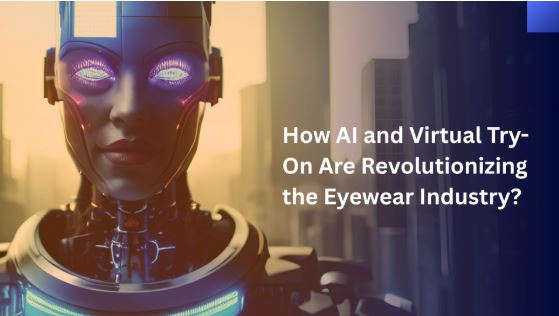
The AI virtual try-on eyewear industry is rapidly gaining momentum by enabling users to virtually test different frames in real time using their smartphones or desktops. Companies now have the opportunity to provide an extremely interactive and personal shopping experience by integrating AI, augmented reality, and facial recognition.
This innovation not only improves customer satisfaction but also lessens uncertainty in making purchases online. Consequently, virtual try-on solutions run through AI are transforming consumer behavior and business strategies within the eyewear market.
What is AI Virtual Try-On Technology?
AI virtual try-on is a modern digital technology that enables users to virtually try on eyewear through their smartphone, tablet, or desktop camera. It uses artificial intelligence and augmented reality (AR) to build a real-time simulator of how various frames will appear on the face of a user, without necessarily putting them on.
This technology is operated through computer vision and facial recognition to identify crucial facial features like the eyes, nose, and the shape of the face. According to this information, it precisely superimposes 3D eyewear models into the face of the user, which can be resized, tilted, and positioned to fit realistically. Machine learning algorithms also make the experience more enjoyable through better accuracy and personalized frame suggestions.
The technology is essential in the developing AI virtual try-on eyewear industry in order to reduce the gap between online and offline shopping. Not only does it enhance the confidence of the users, but it also provides a very interactive and convenient shopping experience.
Evolution of the Eyewear Industry
Eyewear has moved beyond conventional in-store shopping to digital innovation-led shopping. Convenience and personalization are being improved with the emergence of technologies such as AI and virtual try-on due to the increase in eCommerce. The AI virtual try-on eyewear market is transforming the online shopping of eyewear that customers do today.
1. Old Fashioned Eyewear Shopping Problems
Over the decades, eyewear purchases were confined to brick-and-mortar stores where customers were required to handle various frames manually. This was usually time-consuming and had several choices based on what was in stock in the stores. Store assistants were also very important to the customers, and this made the shopping experience less self-reliant and even inconvenient.
2. Change of Offline Stores to eCommerce
As online shopping has emerged, the eyewear industry has shifted slowly towards the digital platform. E-commerce has helped customers to view a variety of frames in the comfort of their homes. Nonetheless, there was a lack of trial of products before purchase, which raised doubt and uncertainty among the customers.
3. Demand More Customer Experience
Due to the changes in consumer expectations, the demand for more interactive and personalized shopping experiences has increased. Customers wanted a convenient experience that did not compromise their trust in their decisions, particularly of products such as eyewear that rely on both the fit and the look.
4. Entry of AI and Digital Solutions
As a solution to these issues, the industry turned to such innovative technologies as AI and virtual try-on. These technologies have revolutionized the AI virtual try-on eyewear business and helped brands to provide real-time visualization, personalized suggestions, and a smooth experience between online and in-store shopping.
Key Technologies Behind AI Virtual Try-On
The AI virtual try-on is based on a blend of advanced technologies to provide precise, real-time, and personalized eyewear experiences. These technologies are used collaboratively to recreate the appearance of frames and how they should appear on the face of a user. They are essential in improving the user experience and business efficiency in the emerging AI virtual try-on eyewear industry.
1. Artificial Intelligence (AI)
The virtual try-on systems are powered by advanced technologies offered through AI development services, enabling them to understand user preferences and facial features. These systems help recommend the right frames based on face shape, style, and past behavior. As machine learning algorithms evolve, they become more accurate over time, making the overall experience smarter and highly personalized.
2. Augmented Reality (AR)
AR enables people to view virtual eyewear on their faces in real time by using their phone camera. It creates an interactive experience, where the users are able to move their heads and view the frames from different angles. This increases the interactivity of online shopping and is a close simulation of in-store trials.
3. Computer Vision
Eyes, nose, and ears are facial landmarks that are identified and tracked by the computer vision technology. This makes the virtual glasses well-adjusted and set on the face. It is a critical part in providing a realistic and true-to-life try-on experience.
4. 3D Modeling & Facial Recognition
Facial recognition is a chart of the shape of the user’s face, and 3D modeling offers comprehensive digital illustrations of eyewear frames. They work collectively to make sure that the sizes, depth, and proportions of frames are adjusted. The combination assists in giving a more realistic and accurate image.
5. Scalability: Cloud Computing
Fast data processing and storage are facilitated by cloud computing, which means that virtual try-on functions can work well across devices. It encourages real-time performance and renders it scalable to accommodate numerous users. This makes the technology viable and cost-effective to viewers across the globe.
Benefits for Eyewear Brands and Retailers
The introduction of new technologies is providing businesses in the AI virtual try-on eyewear sector with major benefits. The virtual try-on is rendering brands competitive in the dynamic market by improving customer relations and increasing sales.
1. Increased Sales and ROI
Virtual try-on will reduce doubt in buying since they will be able to see what the frames will look like before making a purchase. This will increase confidence in decision-making, hence more conversions will be realized. Consequently, there are enhanced sales and improved ROI of the brand.
2. Improved Customer Engagement
The shopping experience is more interactive and enjoyable with interactive try-on features. The customers receive an opportunity to test the different styles in a limited time frame, and this will result in them spending more time on the platform. This enhanced engagement enhances brand association and customer retention.
3. Data-Driven Insights
Intelligent systems gather useful customer preferences, behavior, and fashionable style data. Companies can use these insights to maximize inventory, tailor marketing, and enhance products. This results in more intelligent and informed business decisions.
4. Market Competitiveness
The ability to provide a novel and convenient online shopping experience makes brands that implement AI virtual try-on unique. It makes them innovative and customer-oriented in a highly competitive market. This competitive advantage aids in attracting and retaining more customers.
Challenges and Limitations
As much as the AI virtual try-on eyewear industry offers numerous advantages, it also presents several challenges that businesses must overcome to ensure seamless adoption and build user trust making it essential to hire AI developers who can effectively address these complexities.
1. Problems with accuracy
The success of the virtual try-on greatly relies on the environment and equipment used by the user. Facial detection and frame alignment may be compromised by poor light or poor quality of the camera. This could lead to inaccurate or unrealistic previews.
2. Facial Data Privacy
Virtual try-on systems are based on facial feature capture and analysis, which is a source of concern with regard to data privacy. Without relevant security measures, users might be reluctant to provide personal information. It is vital to ensure that the data protection laws are adhered to.
3. High Implementation Cost
The process of the development and integration of the AI and AR technologies can be costly, particularly to small and mid-sized companies. Costs are software development, infrastructure, and maintenance. This can be one hindrance to many retailers.
4. Technical constraints in small businesses
SMEs might not have the technical know-how or funds to adopt high-tech virtual try-ons. Adoption can be limited due to limited budgets and infrastructure. Consequently, they might not be able to compete with bigger tech-enabled brands.
Conclusion
The virtual try-on eyewear industry is revolutionizing the way customers shop for eyewear through a powerful blend of convenience, customization, and technology, further enhanced by AI integration services. Not only does it optimize the buying experience, but it also helps brands maximize sales, engagement, and data-driven decision-making.
Although challenges such as cost and data privacy still exist, continuous advancements are making these solutions more accessible. With the industry rapidly evolving, AI-powered virtual try-on will soon become a standard feature, transforming the future of eyewear retail for both consumers and businesses.