Grip Strength
Here’s something you can try with a carrier bag. Fill it with tins or books, hold it by the handles at your side and see how long you last. Your arm won’t be the problem. Your fingers will start to uncurl first, usually long before you expect.
That gap, strong arms and tired hands, is what the exercises below are for. Grip is a mix of squeezing, pinching, hanging on and opening up. A hand grip strengthener only covers the first. Cover the rest and your hands, wrists and elbows all end up happier.
1. Gripper squeezes
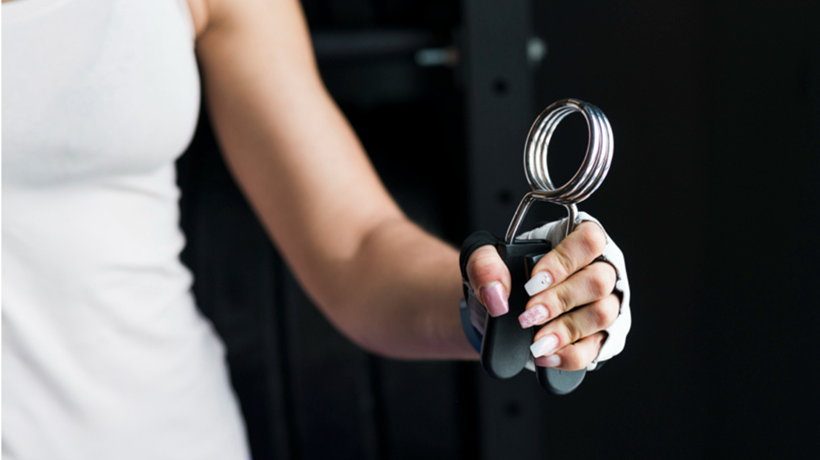
Yes, the obvious one. Put the fixed handle deep in your palm, close the gripper until the handles actually touch, then let go slowly. Start the squeeze with your little and ring fingers, because the index and middle fingers love to hog the work and leave those two weak.
Three sets of eight to twelve per hand, about ninety seconds of rest between them. If you’ve got a digital hand grip strengthener, check the number after each rep. A lazy squeeze always scores lower than it felt.
2. Dead hangs
Hang from a bar. That’s the exercise. A few short holds beat one heroic attempt, and when your shoulders start creeping up to your ears, you’re done.
3. Farmer’s carries
Heavy thing in each hand, walk around. Dumbbells, kettlebells, two full buckets from the garage, doesn’t matter much. Your forearms burn first, then you realise your upper back and core have been working too. Go heavy over a short distance if you want strength, or lighter and further for stamina.
4. Plate pinches
Take a smooth weight plate, squeeze it between your thumb and fingertips and hang on. It doesn’t sound hard until about twenty seconds in. Pinch is a separate skill from squeezing a gripper, and it’s what you lean on when you lift a box by its edges or carry a plank.
5. Towel hangs
Throw a thick towel over the bar and hang onto both ends. Because it’s soft and bulky, your fingers can’t wrap round it neatly, so they work overtime. Finding it too tough? Keep your toes on the floor or a chair and let your legs share the load.
6. Wrist curls, both ways
Rest your forearm on a bench or your thigh, hold a light dumbbell and curl it up using only your wrist. After that, turn your palm to face down and repeat. Palm-up hits the underside of the forearm, palm-down hits the top.
Go light. This isn’t a lift to show off with, it’s about control. And don’t skip the palm-down version, which almost everybody does. The top of the forearm gets neglected all day long, and that’s one common route to cranky elbows.
7. Rubber-band openings
Easily the dullest exercise here, and I’d argue one of the most useful. Loop a strong rubber band around your fingers and thumb, then spread your hand open against it, slowly. Three sets of fifteen to twenty-five.
Squeezing builds the closing muscles. Opening builds their opposite numbers. Two minutes of band work now and then keeps the whole forearm in proportion, and it costs about as much as a packet of bands.
8. Bouldering
Climbing asks your hands to crush, pinch, hang and hold, all at once, on holds that are often smaller than you’d like. No wonder climbers have such frightening grip.
Be careful here. Finger tendons are slow to toughen up, and going hard too early is how people end up with strained tendons or even a torn pulley. Do your band work and wrist curls beforehand, keep to easy problems at the start, and count progress in months.
Fitting it into a week
No need to do all eight. One setup that works: gripper and band work on one day, carries and hangs on another, pinches and wrist curls on a third, never two days back to back. Forearm muscle gets stronger quicker than tendon, so it’ll ask for more weight long before the tendons can take it. Change either reps or resistance in a given week, not both.
Every six to eight weeks, ease off for a few days.
Where people slip up
Training every day at full effort. Ignoring the weaker hand. Leaving out the band work. Another trap is pushing through sharp pain, tingling or weakness that lingers. That means stop and get it looked at. A dull ache by the elbow is much less worrying. Cut back, add the band work, and build up slowly.
A few quick questions
Do I actually need a hand grip strengthener?
Strictly speaking, no. Hangs and carries build serious grip all by themselves. But a gripper lets you add load in tiny steps, and that’s harder to do with bodyweight once you’re already strong.
How often?
Two or three sessions a week is enough.
How long until it shows?
A firmer feel after a few weeks. Tendons take longer, two to three months.
What about arthritis or carpal tunnel?
Physios do use grip work, but if you have a diagnosis, get a clinician to set it up.
Last word
Pick three or four and stay with them for a couple of months. Leave a hand grip strengthener where you’ll trip over it, begin lighter than feels right, and wait before judging. Week one tells you nothing. more