

Agentic AI is transforming business operations
Businesses are using AI to improve their operations in many different ways, as AI continues to evolve at an ever-quickening pace. AI applications were previously used primarily for automation, chatbots, or data analytics, but recently, there has been a significant shift as businesses begin using a new form of AI referred to as agentic AI, which is fundamentally different from traditional AI.
Agentic AI is designed to support companies in automating operations and managing workflows without needing human supervision or input. It integrates intelligent decision-making capabilities into automated systems, allowing them to complete a variety of tasks independently and effectively generate value for a company by automating processes such as customer service or supply chain management and increasing the overall productivity and profitability.
What Is Agentic AI?
An AI that can act as an independent agent is referred to as an agentic AI. Systems of this type are capable of recognizing their desired outcomes and generating a strategy to achieve them. Agentic AI can formulate its own plan without receiving a step-by-step set of instructions. They can also learn from their experience and make decisions based on prior results.
In comparison to traditional AIs, which may produce a report only upon receiving a command, an agentic AI has the capability to independently collect data, analyze trends, produce reports, identify potential problems, and communicate insights to the appropriate parties without constant assistance. The ability of agentic AI to operate autonomously is what distinguishes it from previous forms of automation technology.
Many companies are now interested in using Agentic AIs because they allow computer programs to operate more like intelligent digital employees rather than just machines. This interest is reflected in the rapid growth of the broader industry; according to Statista, the global AI market is expected to grow by over 28% annually through 2030, with autonomous agents representing a significant portion of that expansion.
How Agentic AI Enables Autonomous Business Systems
Agentic AIs allow for the creation of self-operating systems by businesses all around the world. Through many AI agents collaborating across departments to accomplish jobs, these types of business systems are able to manage themselves without the assistance of a human being.
To use these systems, businesses will typically start by establishing goals regarding customer engagement, sales, costs, or inventory management. Once this goal has been established, the AI system will proceed to break up the goals into smaller tasks and will subsequently establish a method of accomplishing those tasks.
Once these tasks are identified, the AI agents will implement the actions associated with those tasks. For instance, an AI agent can analyze customer behaviors, produce marketing content, determine pricing strategies, monitor operational activity, and generate reports. In addition to executing these tasks, the AI system continues to monitor its outputs with real-time data in order to make continuous improvements to its operations.
As a result of agentic AI, many of the daily operations of businesses around the world are able to operate on their own without any ongoing involvement from a human.
Agentic AI in Customer Support
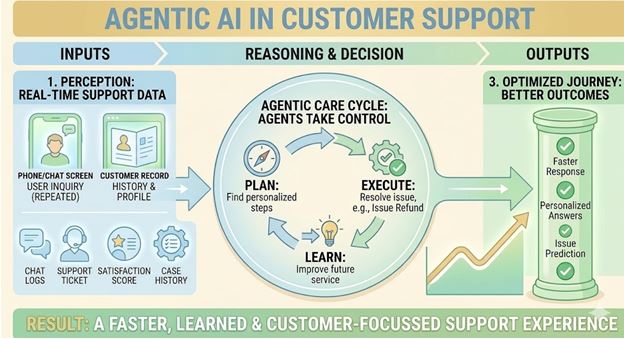
Agentic AI is extremely popular within the customer support industry. On the other hand, while chatbots can handle basic requests like answering questions, they often struggle with more complicated inquiries due to limitations in their programming. Compared to traditional chatbots, agentic AI systems have significantly better capabilities because they utilize advanced algorithms that enable them to understand a customer’s intent, access the company’s database, assist in problem-solving, and even make decisions during customer interactions.
For example, with an AI support agent, businesses can:
- Process refund requests and/or initiate refund transactions
- Update a customer’s account information
- Recommend an appropriate solution to a customer’s issue
- Escalate a serious issue to a human support representative if necessary
- Learn from prior interactions to provide an improved response
In addition, companies that purchase AI support agents can utilize these agents to provide customers with faster, more personalized service experiences while also alleviating the burden of supporting multiple customers on support teams.
Agentic AI in Marketing and Content Operations
The marketing space is rapidly changing with the increased use of Agentic AI. Businesses today employ AI agents to help automate marketing processes from start to finish with little or no human involvement.
An agentic AI solution can research trending topics, identify your target audience, write content that is optimized for search engines, schedule posts on social media, and analyze your campaign’s performance to determine the best way to optimize your ongoing plans, all without using any human resources.
By having AI agents handle repetitive, data-driven marketing tasks, companies can enable their marketing teams to concentrate more of their efforts on the creative, branding, and strategic components of their business while using AI to take care of the operational work running behind the scenes.
Transforming Sales and Lead Generation
Autonomous AI systems have also helped sales teams. Agentic AI can help sales teams identify new leads, track customer behavior, personalize communication, and automate follow-up communications.
For example, AI agents can track how a user engages with a website, email, or ad. After tracking how the user engaged with the website, email, or ad, AI agents can send recommendations based on the customer’s preferences. AI agents can automatically schedule meetings for customers or suggest ideal times to contact a lead.
By automating repetitive sales processes, companies can improve productivity and provide more time for sales professionals to build relationships with their customers. AI transforms sales, finance & operations by helping organizations improve customer engagement, automate workflows, and increase business efficiency.
Improving Supply Chain and Operations
Agentic AI is being used by many industries, including retail, manufacturing, and logistics, to help them increase their efficiency by providing the ability to monitor inventory, forecast demand for items, optimize the shipping process, and detect supply chain disruptions before they turn into serious issues.
Agentic AI allows companies to make real-time decisions and reduce their operational delays and costs to improve overall productivity. Additionally, because AI constantly analyzes all data and then auto-adjusts operations to integrate any changes in the market, companies can react more quickly and easily adapt their business. This makes autonomous AIs a very valuable tool for maintaining efficient operations within increasingly complex supply chains.
This makes autonomous AIs a very valuable tool for maintaining efficient operations within increasingly complex supply chains. Agentic AI is transforming business operations by helping organizations improve operational efficiency and respond to market changes faster.
Agentic AI in Financial Management
Finance departments are leveraging Agentic AI to perform routine finance functions comprehensively and automate their operations. Agentic AI relies on AI systems that support finance departments by managing how they monitor expenses, produce reports, project future sales, and detect potentially fraudulent transactions.
Using agentic AI allows businesses to take advantage of machine learning capabilities so they do not have to manually review financial data for hours, but instead can use AI agents to quickly and accurately process their information. By utilizing Agentic AI, companies are able to make faster financial decisions and minimize possible human error.
Agentic AI improves the financial planning function by analyzing historical and current data sets to anticipate future trends and provide recommendations to businesses on how best to proceed.
Benefits of Self-Operating Business Systems
The key advantages of agentic AI make many businesses choose Agentic AI as a significant advantage for their organization. The biggest advantage is becoming more efficient. Tasks that have always taken hours of manual labor can now perform automatically, allowing for significant time savings.
The second major advantage is scalability. Autonomous systems can quickly scale up or down based on increasing workloads without having to bring on new employees to do it. This allows businesses to build their businesses much more easily than before.
Agentic AI also enhances the consistency and accuracy of your operations. Because AI systems are based on data-driven processes, you reduce the opportunities for error by humans and create an environment of smoother operations.
Finally, when you implement Agentic AI, you can reduce your overall costs for operating a business by automating repetitive tasks as well as increasing the productivity of your employees throughout your organization.
Challenges and Limitations
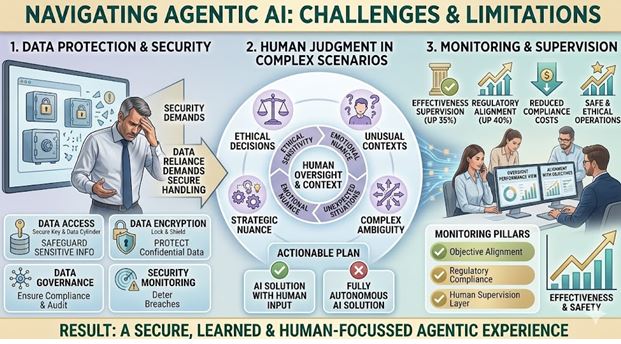
Numerous advantages exist for businesses using agentic AI; however, businesses must overcome several challenges associated with implementing it within their organizations. The most important thing is ensuring data protection and security due to the reliance of AI solutions on large quantities of data, which can include sensitive or confidential information.
Another significant challenge to consider when implementing an agentic AI solution is developing an understanding of human judgment in very complex situations (and making decisions based solely on data). In many cases, AI systems may not have emotional or ethical capabilities, nor can they anticipate unexpected, unusual situations.
Lastly, businesses must have appropriate systems to monitor and evaluate the effectiveness of their autonomous AI agents in alignment with the organization’s stated objectives and applicable regulations. Organizations that currently fail to have systems in place to effectively supervise their AI-supported operations tend to favour a hybrid implementation approach to AI, whereby a human assigne the role of supervising the operations of AI-based solutions.
The Future of Autonomous Business Systems
With automation becoming the future of business operations, Agentic AI will be an essential part of this process. As technology advances, companies will likely migrate toward interconnected ecosystems of AI agents that handle workloads, make decisions, and optimize performance in real-time.
In the next few years, many companies will likely implement intelligent systems that can operate large parts of their business independently. Humans will still play an important role; however, they will likely take on more of a strategic, creative, innovative, and oversight role.
Businesses that adopt Agentic AI early may have a competitive edge by increasing their efficiency, lowering their costs, and being able to meet market changes more quickly.
Conclusion
Using Agentic AI is changing how businesses operate, creating fully autonomous self-operating systems that allow companies to automate the complex processes involved in their business operations (customer service, marketing, finance, and supply chain management) without human intervention. Traditional automation solutions cannot think, plan, act, or improve themselves; however, they require ongoing input and direction from people.
Agentic AI presents a new approach to automating the process of executing complicated business transactions and improving productivity. In spite of continuing challenges around data security and human oversight, the impact of agentic AIs on organizations is already obvious. These technologies provide organizations with smarter, faster, and more scalable solutions that will help them prepare for future business needs.
In time, as more organizations adopt AI technologies, autonomous business processes will likely become an accepted part of the digital economy. more