
machine learning development
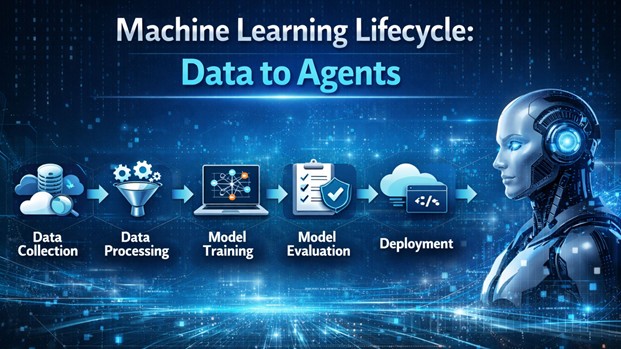
Most software projects die in the lab. They look great as a demo but fail when they hit real data. To build a machine learning development solution that lasts, you need a clear loop. Today, that loop goes far beyond a simple prediction. It leads to the AI agent. This is a system that doesn’t just suggest; it acts.
The Framework of Machine Learning Development
Turning a theory into a product requires a steady process. This is what we call machine learning development. It is an iterative pipeline. It turns experiments into tools people can rely on by aligning goals, data, and code.
The first step is defining the goal. You must turn a business need into something you can measure. If you want to cut down on errors by ten percent, that is your target. Without this, projects often stop at the prototype stage.
Data is the base of any machine learning solution. You need pipelines to pull info from internal logs or third-party sellers. Raw data is often messy. You have to fix missing values and find strange patterns before you start.
To make the model work better, you pick and change variables. Modern teams use feature stores to save these, so they can use them again later. Saving every version of your data is a must. You want to be able to see exactly which data led to a specific answer if someone asks later.
Better Models and Constant Testing
Once the data is ready, the testing starts. You pick an algorithm based on what you need. Maybe you need to group items or predict a price.
Training is about making small changes to find the best fit. For example, a model might use a formula to see how far off it is.
You keep tuning until the error is small. After that, you test it on data the model hasn’t seen yet. This stops the model from just memorizing the old data. You also have to check if the model is fair to everyone. In some fields, you have to show that your model doesn’t have a bias.
Why AI Agents Are Different
Old-school automation is like a train on a track. It is fast but cannot move if there is a rock in the way. An AI agent is different. It is like an all-terrain vehicle. It can see what is happening, think about a goal, and take steps to finish a job without you watching over it.
These AI agents Solutions move from just answering a prompt to finishing a whole process.
A big part of this shift comes from NL services. These let agents read human language, look through contracts, and talk to customers. They use large models as their brain to make sense of the world.
Architecting Autonomy: Reasoning, Memory, and Tools
The architecture of an AI agent has several components that work together to enable independent action. The model acts as the brain, providing the capacity for natural language processing and decision-making.
Memory Systems
They are required to maintain context. Short-term memory stores the current interaction details, allowing for multi-turn dialogues.
Long-term memory stores factual knowledge and past experiences. These are implemented using vector databases and Retrieval-Augmented Generation. They are responsible for letting the agent to recall preferences and learn from previous successes or failures.
Planning
Agents use task decomposition to break a complex goal into smaller steps. They might use utility functions to evaluate different paths and choose the one that maximizes a specific benefit, such as speed or cost-effectiveness.
Tools Integration
Tool integration allows the agent to interact with the physical and digital world. Through APIs, an AI agent can access databases, send emails, or update CRM records. The ability to use tools transform a predictive model into a digital worker that can execute transactions and manage workflows end-to-end.
Building Context with RAG and Graphs
A major hurdle in machine learning development is keeping the agent grounded in facts. You don’t want it to make things up. Two ways to fix this are Retrieval-Augmented Generation (RAG) and Knowledge Graphs.
RAG pulls the right info from a file when a question is asked. This is great for looking through PDFs or emails. It finds text that looks similar to the query.
Knowledge Graphs are different. They map out how things are related. A graph knows a product, who made it, and where it is in the warehouse. This makes the logic easier to follow.
| Grounding Method | Strengths | Limitations |
| RAG | Rapid deployment, works with PDFs | Lacks deep relationship reasoning |
| Knowledge Graphs | High precision, explainable logic | Requires upfront data modeling |
| Graph RAG (Hybrid) | Combines breadth and depth | Higher architectural intricacy |
Many strong AI agents solutions use a mix of both. This gives the system both a wide reach and deep logic.
Managing the Agent Loop
When agents start doing real work, they need a system to manage them. This is called AgentOps. Since agents act on their own, testing them is a big deal. One bad move could hit thousands of users.
You have to watch for drift in how they think. If the data changes, the agent might start making poor choices. If that happens, you need to trigger a retraining loop.
Rules are also needed. You have to set limits on what an agent can do. Maybe it can draft an email but not send a payment without a human clicking OK. You also need to keep logs of every choice the agent makes for safety.
Industry Impact and Case Studies
The implementation of machine learning development and AI agents is transforming various sectors by improving efficiency and reducing costs.
Finance and Banking
In the financial sector, agentic systems are used for fraud detection, risk audits, and personalized financial advice.
Companies like JPMorgan Chase use agents to automate loan approvals and compliance monitoring, reducing the manual workload for employees.
In investment management, agents analyze vast amounts of market data to provide tailored strategies based on individual risk tolerance.
Healthcare
AI agents in healthcare assist with diagnostic support by analyzing patient history and lab results to recommend treatments.
They also monitor patients with chronic conditions via wearable devices, adjusting care plans, and scheduling appointments when necessary. This leads to better patient outcomes and reduced hospital admissions.
Additionally, the users of wearables IoTs are using TinyML services and on-device intelligence to keep track of their health and get
Retail and Supply Chain
Retail giants like Walmart use AI agents to automate personal shopping and facilitate customer service.
In the supply chain, agents monitor logistics data to predict disruptions and automatically reroute shipments to avoid delays.
This responsive approach optimizes inventory levels and reduces operational costs.
| Industry Sector | AI Agent Application | Reported Benefit |
| Finance | Autonomous Risk Audits | Improved compliance and fraud detection |
| Healthcare | Patient Monitoring | Better care and faster turnaround |
| Retail | Personalized Shopping | Higher customer satisfaction and sales |
| Supply Chain | Real-time Rerouting | Reduction in unplanned downtime |
| Manufacturing | Predictive Maintenance | Lower maintenance costs and higher safety |
The Business-to-Agent Strategy
There is a shift happening in how businesses talk to each other. It is called the B2A strategy. Soon, your main customer might not be a person, but that person’s AI proxy.
If people use agents to filter their mail and find products, your site needs to be agent-ready. This means having clear APIs and data that an agent can read quickly. For more on this, check out agentic ai in b2b saas.
The point of these agents is to drop the cost of doing business. They save time on searching, talking, and signing deals. By making better choices with less effort, they let a company grow without getting bogged down in the small stuff.
Perspective
The machine learning development cycle is what turns a good idea into a tool you can use. By following a clear path from data to AI agent, the best AI/ML service providers build something that stays accurate and acts on its own. Using NL services grounded in real data helps create workers that truly help.
As things move forward, the focus will stay on making these systems repeatable and safe. Combining clear goals with automated loops ensures your experiments turn into products that last. We are moving to a world where humans and machines work as partners to get things done. more